IB Math IA Explained Clearly — Format, Purpose, Criteria A–E Breakdown August 18, 2020 | 5 min Read

IB Math IA Explained Clearly — Format, Purpose, Criteria A–E Breakdown

This comprehensive guide breaks down the full structure, purpose, and assessment criteria (A–E) of the IB Mathematics Internal Assessment. Learn how SL and HL expectations differ, what examiners truly look for, and how topic selection directly impacts scoring potential. Discover strategic advice on presentation, mathematical communication, personal engagement, reflection, and depth of mathematics. If you are aiming for a 6 or 7 in IB Mathematics, this guide clarifies exactly how to approach your IA with structure, precision, and intellectual ownership.

Introduction: Understanding the Role of the IB Math IA

The IB Mathematics Internal Assessment (IA) is a compulsory mathematical exploration that contributes 20% to a student’s final IB Mathematics grade. Unlike external examinations, which are time-restricted and standardized, the IA allows students to engage in an extended, self-directed investigation of a mathematical topic of their choosing.

The IA is first assessed internally by the classroom teacher and subsequently moderated by external IB examiners. If internal marking is found to be overly generous or excessively strict, scores may be adjusted accordingly. The final IA mark is awarded out of 20 points and combined with the externally assessed 80% to determine the overall course grade.

Understanding the structural and philosophical purpose of the IA is essential before beginning the exploration.

The Purpose of the IA: Beyond Examination Performance

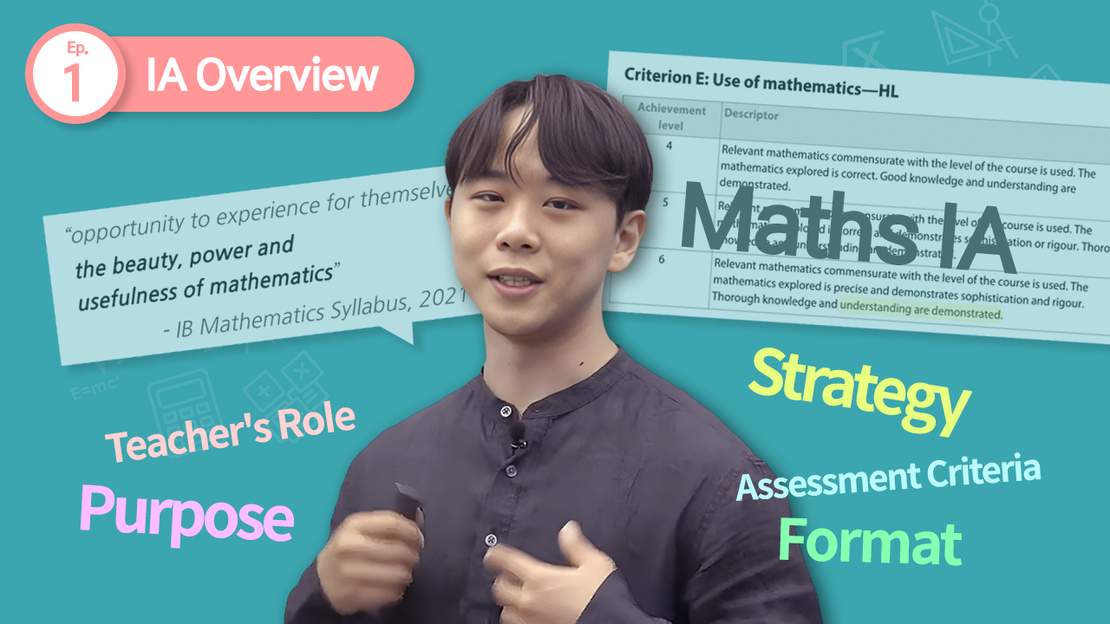
The IA exists to provide students with an opportunity to experience mathematics outside the constraints of examination conditions. According to the IB subject guide, students should develop an appreciation for the power, elegance, and practical utility of mathematics.

The IA encourages students to:

  • Formulate their own research questions
  • Explore mathematics independently
  • Apply appropriate technological tools
  • Move beyond textbook-style procedural exercises

The objective is not merely to produce calculations, but to demonstrate authentic mathematical inquiry.

Structure and Formal Requirements

The recommended length of the IA is 12–20 pages, double-spaced, including formulas, graphs, diagrams, tables, and appendices. References are not included in the page limit. Students are typically advised to dedicate approximately 10–15 hours to the project.

Some institutions may require preliminary proposals, outlines, or reflections to ensure academic integrity and authenticity. However, the mathematical investigation itself must remain the student’s independent work.

The Role of the Teacher and Student Responsibility

IB guidelines specify that teachers may provide guidance, advice, and feedback on general direction, but they may not edit, rewrite, or directly correct student work. The IA must represent the student’s independent thinking.

Three principles therefore become central:

Initiative. Independence. Intellectual flexibility.

Students must actively seek clarification, conduct research, justify their methodology, and defend their conclusions. Passive participation is incompatible with success in the IA.

Assessment Criteria A–E Explained

The IA is evaluated using five assessment criteria totaling 20 marks.

Criterion A: Presentation (4 marks)

Criterion A evaluates coherence, organization, and conciseness. A strong IA demonstrates a logical structure that remains focused on its research aim. Graphs, formulas, and tables should be integrated within the body of the text at appropriate points rather than isolated in appendices. Excessive repetition, irrelevant computation, or digression weakens performance.

Clarity and structural discipline are essential.

Criterion B: Mathematical Communication (4 marks)

This criterion assesses precision in notation and clarity in mathematical expression. All variables, symbols, and terminology must be clearly defined and consistently used throughout the exploration. Calculator-style notation (e.g., asterisks for multiplication or simplified symbolic shortcuts) should be avoided. Proper mathematical formatting tools should be used.

Mathematical language must reflect academic standards.

Criterion C: Personal Engagement (3 marks)

Personal engagement measures authenticity, creativity, and independence. It is insufficient to merely claim interest in a topic. Students must demonstrate meaningful personal connection through thoughtful development and contextual understanding.

For example, a student genuinely interested in finance might investigate portfolio optimization. A student fascinated by acoustics might explore Fourier analysis in sound wave modeling. The key lies in intellectual ownership rather than superficial enthusiasm.

Criterion D: Reflection (3 marks)

Reflection involves evaluating findings, considering limitations, and assessing the effectiveness of chosen methods. Students should analyze whether alternative approaches could have been more efficient or insightful. Reflection is not a summary but a critical examination of the exploration’s significance.

Intellectual maturity is demonstrated through analytical reflection.

Criterion E: Use of Mathematics (6 marks)

Criterion E carries the highest weighting and often determines overall performance differentiation. Students must demonstrate appropriate mathematical depth consistent with their course level (SL or HL). Calculations must be accurate, relevant, and logically developed. Mathematical processes should not merely appear; they must be meaningfully applied and justified.

The choice of topic is particularly crucial for Criterion E, as insufficient mathematical depth restricts scoring potential.

SL and HL Expectations

While the assessment framework is identical for SL and HL, expectations differ in mathematical sophistication.

SL students are expected to demonstrate clear and accurate understanding within syllabus boundaries. Overly complex mathematics is unnecessary.

HL students must exhibit greater precision, sophistication, and rigor. This may involve integrating multiple mathematical concepts or extending analysis beyond straightforward application. However, complexity must never compromise clarity.

Strategic Considerations for High Achievement

Criteria A and B represent opportunities for secure marks; structural and communication errors are avoidable.

Criteria C and E depend heavily on topic selection and depth of development.

Criterion D requires deliberate reflection and often benefits from structured consultation with a teacher.

Ultimately, the IA rewards structured reasoning, precise execution, intellectual honesty, and authentic engagement.

Conclusion

The IB Math IA is not designed to reward the most complicated topic. It rewards clarity of thought, disciplined mathematical reasoning, coherent presentation, and meaningful personal engagement.

When students approach the IA as a genuine academic investigation rather than a procedural requirement, high achievement becomes not only possible, but probable.

Mathematics

Mathematics

Explore IB Math Analysis & Approaches and Applications & Interpretation, including calculus, statistics, functions, and exam …

comments powered by Disqus