IB Biology IA: How to Nail the Conclusion for Top Marks June 18, 2020 | 4 min Read

IB Biology IA: How to Nail the Conclusion for Top Marks

Struggling with your IB Biology IA conclusion? This guide explains exactly what examiners expect in Criterion C, including how to restate your research question, synthesize data trends, address anomalies, link results to biological theory, and integrate peer-reviewed sources. Learn how to structure a scientifically justified conclusion that secures top marks.

IB Biology IA: How to Nail the Conclusion for Top Marks

Why the Conclusion Determines Your Final Band

In IB Biology IA, the conclusion is assessed under Criterion C. The difference between a mid-level conclusion (3–4 marks) and a strong, high-scoring one (5–6 marks) lies in depth and justification. A strong conclusion does not merely describe results — it justifies them using scientific reasoning and directly answers the research question.

Your conclusion must be fully aligned with your analysis. It should demonstrate that your interpretation of data is logically consistent with what you actually presented in your results section.

What Examiners Expect in Criterion C

To score highly, your conclusion must:

  • Restate or rephrase the research question or hypothesis
  • Summarize the most important findings (not every data point)
  • Identify major trends and significant anomalies
  • Link results to relevant biological theory
  • Support claims using accepted scientific literature

Importantly, you should not repeat your entire analysis. If you already explained trends in depth earlier, do not rewrite them. Instead, synthesize the most critical insights concisely.

Step 1: Restate the Research Question

Begin by clearly reminding the reader what your investigation aimed to discover. For example:

“This investigation aimed to determine how light intensity affects the rate of photosynthesis.”

This immediately refocuses the conclusion on the purpose of the experiment.

Highlight the main patterns observed in your data. For example:

“The data showed an initial increase in photosynthetic rate between 100 and 400 lux, after which the rate plateaued around 400 lux.”

You may reference statistical tests such as ANOVA or correlation coefficients (R² values) to strengthen your claim. Mentioning how well your data fits a trend line demonstrates analytical sophistication.

Use precise and concise scientific language. Avoid unnecessary repetition or vague terminology.

Step 3: Address Anomalies

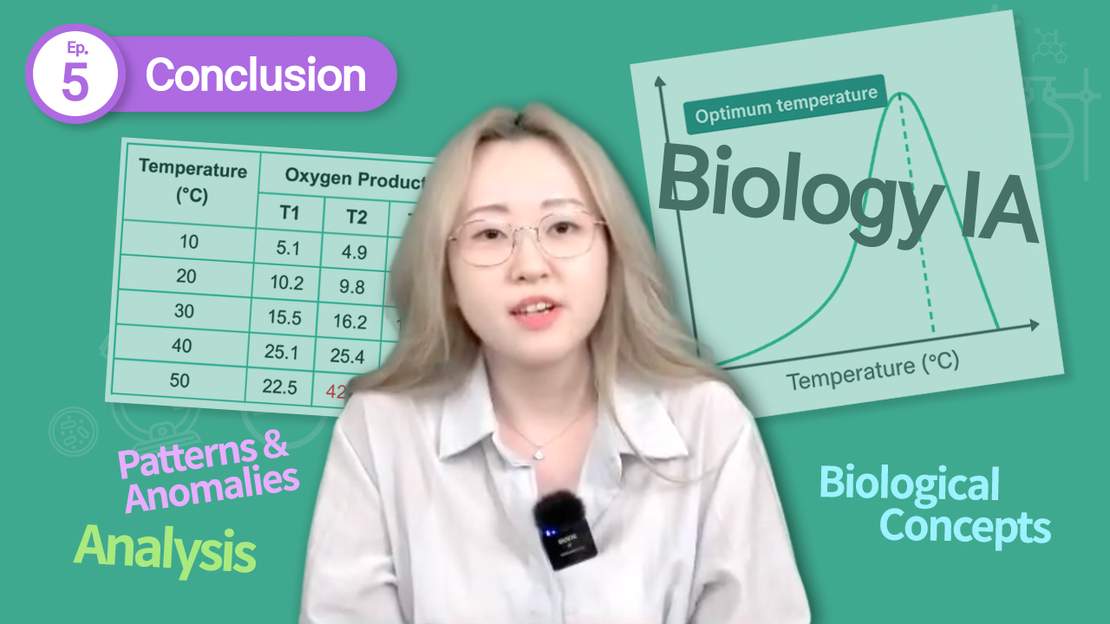
High-scoring conclusions do not ignore irregularities. If an outlier appears — for example, a second trial at 50°C producing unexpectedly high enzyme activity — you must acknowledge it.

You should propose plausible scientific explanations, such as:

  • Measurement inconsistencies
  • Sensor calibration issues
  • Environmental disturbances
  • Experimental handling errors

Detailed qualitative notes taken during experimentation become extremely valuable here.

This is where many students lose marks.

Your findings must be connected to scientific background. For example, if catalase activity decreases above 40°C, you should explain this through enzyme denaturation. High kinetic energy disrupts hydrogen bonds, altering secondary and tertiary protein structure.

If the concept is outside the syllabus, additional research is required. Cite peer-reviewed journal articles with DOI numbers to support your explanation.

For example:

“The observed optimum temperature of 40°C aligns with findings reported by Smith (2000), who demonstrated a similar peak in catalase activity.”

Always use correct in-text citation formatting (APA, MLA, or your school’s required style).

Step 5: Integrate Scientific Literature

To strengthen your evaluation:

  • Use peer-reviewed journal articles
  • Ensure sources include authorship and DOI
  • Compare your findings to established studies
  • Highlight agreements or minor differences

For example, if your study examined spinach but a cited study used Elodea, you may argue that both are green photosynthetic plants and thus likely exhibit similar S-shaped responses to light intensity.

Step 6: Explicitly Answer the Research Question

At the end of your conclusion, clearly state:

  • Whether your hypothesis was supported
  • To what extent your data answered the research question

For example:

“The data strongly supports an S-shaped relationship between light intensity and photosynthetic rate.”

Examiners reward clarity. Do not assume the answer is obvious — state it explicitly.

Final Checklist for a 6/6 Conclusion
  • Restated research question
  • Summarized major trends
  • Addressed anomalies
  • Linked to biological theory
  • Supported with peer-reviewed sources
  • Clearly answered the research question

A high-scoring conclusion is not long — it is structured, justified, and scientifically grounded.

Biology

Biology

Develop advanced analytical and essay writing skills through literary and non-literary text analysis in the IB English.

comments powered by Disqus