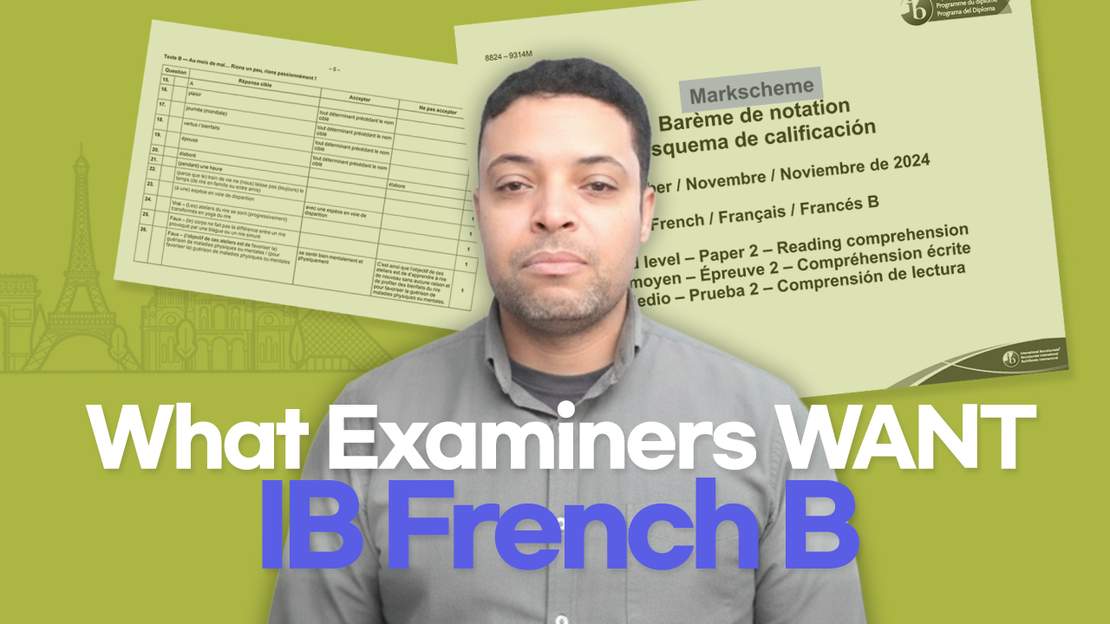
Examiner Insights: What IB French Examiners Really Look For April 18, 2020 | 4 min Read

Examiner Insights: What IB French Examiners Really Look For

Want a 7 in IB French B HL or SL? An official IB examiner reveals what examiners truly look for in the Individual Oral and Paper 1 writing. Discover common mistakes, scoring criteria, and high-band strategies. Learn how to move beyond memorized responses and demonstrate authentic communication, cultural understanding, and analytical depth. Understand the difference between average performance and top-band responses through examiner-level insights.

IB French B is often underestimated.

Many students believe that reading and listening are manageable, but when it comes to speaking (Individual Oral) and writing (Paper 1), confidence drops dramatically. Parents frequently ask: What are IB French examiners actually looking for?

To answer this, we interviewed an experienced IB French teacher and official IBO examiner with nine years of IB teaching experience and three years examining for the IB.

What follows is not theory. It is examiner reality.

The Individual Oral: It’s Not About Perfection

One of the biggest misconceptions about the IB French Individual Oral is that it rewards linguistic perfection.

It does not.

According to the examiner, the first thing examiners look for is clarity and coherence of communication. Can the student express ideas clearly? Can they develop those ideas logically? Can they maintain control of the discussion?

Examiners are not searching for flawless grammar. They are evaluating whether communication is effective and structured.

For HL students, meaningful analysis of the literary extract is crucial. For SL students, thoughtful interpretation of the visual stimulus is expected. Simply describing what is seen is not enough. High-band candidates analyze. They interpret. They connect.

Another critical factor is cultural awareness. Students must demonstrate understanding of Francophone cultures — not only France, but French-speaking regions in Europe, Canada, Africa, and beyond. The strongest responses link the stimulus to cultural habits, traditions, or social contexts.

For example, discussing Noël (Christmas) is not just about mentioning food or decorations. A strong candidate might explore the importance of family gatherings on December 25th, compare it to traditions in their own country, and reflect on cultural similarities or differences. Examiners reward cultural depth — not surface commentary.

The Follow-Up Questions: Where Top Students Separate Themselves

Many students prepare a carefully memorized script for the first part of the oral.

The problem?

Examiners can immediately detect rehearsed answers.

High-performing students stand out during follow-up questions. They think spontaneously. They listen carefully. They respond directly to what is asked instead of forcing memorized content into unrelated questions.

Strong candidates extend their answers with examples and personal reflections. They demonstrate authentic comprehension rather than recitation.

Over-preparation can actually reduce performance. While vocabulary building and fluency practice are essential, memorizing “universal answers” often results in unnatural responses and irrelevant content.

Examiners are trained to recognize authenticity.

Writing (Paper 1): What Makes a Top-Band Response?

When examiners read a top-band IB French B writing response, it is immediately recognizable.

The strongest candidates fully respect text type conventions.

Whether writing an article, speech, blog post, diary entry, or brochure, high-scoring students understand tone, layout, register, audience, and purpose. An article should look and sound like an article. A speech should sound like it is being delivered to an audience.

Many students lose marks because they write everything as a generic essay.

Beyond text conventions, logical structure is essential. Paragraphs must flow coherently. Arguments must progress clearly. Connectives should guide the reader smoothly from idea to idea.

At HL level especially, variety matters. Advanced grammar structures — such as the subjunctive and conditional — should be used naturally and accurately. Vocabulary range and expression diversity are clear indicators of high proficiency.

Recurring Mistakes That Prevent a 7

Across both speaking and writing, examiners consistently observe similar weaknesses.

One major issue is lack of specificity. Students often provide vague or general statements without examples, justification, or detail. Examiners reward developed ideas, not surface commentary.

Another recurring issue in the Individual Oral is over-reliance on memorized scripts, which results in unnatural and limited answers.

In writing, common weaknesses include:

  • Inconsistent verb tenses
  • Incorrect prepositions
  • Weak sentence structure
  • Confusion between text types

An article that reads like an essay will not score highly, regardless of grammar accuracy.

Final Advice from an Examiner

Preparation is important.

But preparation must focus on fluency, adaptability, vocabulary expansion, and structural awareness — not memorization.

Students should train themselves to handle unexpected questions confidently. Teachers may vary in how strictly they conduct orals, so students must be ready for any scenario.

IB French B is not about perfection.

It is about clear communication, cultural understanding, structural control, and authentic language use.

When students understand how examiners think, results change.

French

French

Develop advanced analytical and essay writing skills through literary and non-literary text analysis in the IB English.

comments powered by Disqus