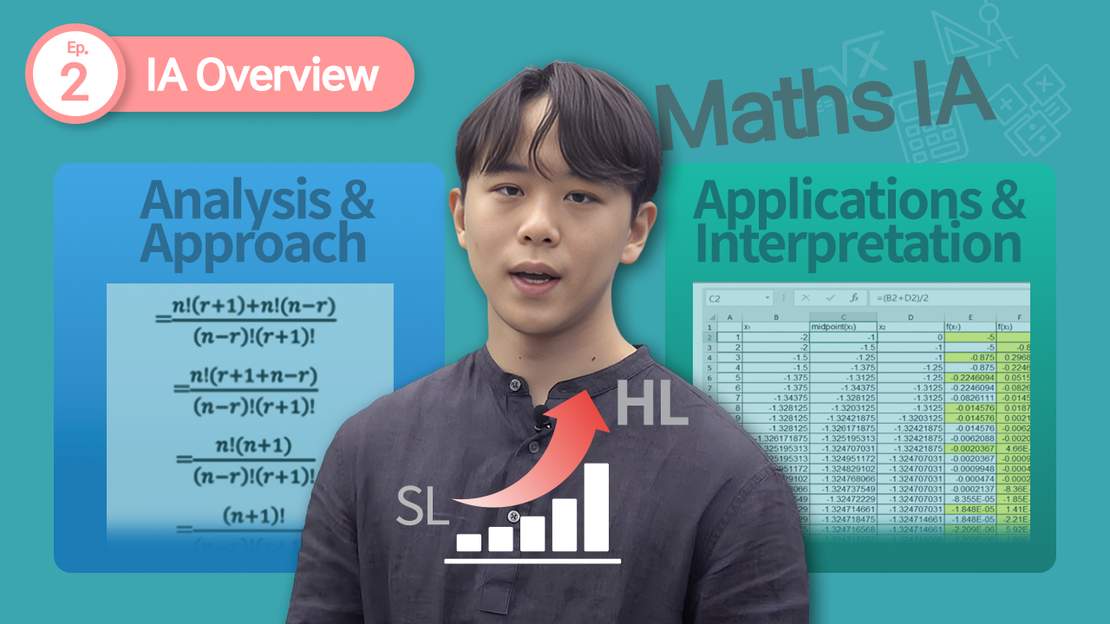
AA vs AI, SL vs HL — How IB Math IA Expectations Really Differ July 18, 2020 | 4 min Read

AA vs AI, SL vs HL — How IB Math IA Expectations Really Differ

Do AA and AI require different IB Math IA approaches? How do SL and HL truly differ in mathematical expectations? This guide breaks down the structural realities behind Analysis and Approaches versus Applications and Interpretation, with a focused explanation of how Criteria E reshapes rigor across levels. Understand what actually changes in depth, precision, and sophistication before choosing your IA topic. Clear strategy begins with clarity about course demands.

“Is your IA defined by your course — or by how you use mathematics?”

When students begin planning their IB Mathematics Internal Assessment (IA), one of the first uncertainties is structural. Does being in Analysis and Approaches (AA) require a different kind of topic than Applications and Interpretation (AI)? Does being in SL mean the mathematics can be simpler than HL? The reality is more nuanced than many expect. While AA and AI differ in philosophical emphasis, the assessment criteria for the IA are identical. The real difference emerges in mathematical orientation and depth — especially when comparing SL and HL. Understanding these distinctions is essential before choosing your topic.

AA: Analysis and Approaches — A Course Built on Mathematical Argument

Analysis and Approaches represents the more traditional pathway of mathematics. It emphasizes calculus, functions, trigonometry, algebraic manipulation, conjecture, and proof. The core objective of AA is logical construction. Students are trained not just to compute, but to justify — to derive formulas, develop structured arguments, and support claims through mathematical reasoning. Because of this emphasis, AA students often gravitate toward IA topics that involve algebraic derivation, symbolic manipulation, theoretical extensions of syllabus concepts, or proof-based reasoning. However, this is a pattern — not a restriction. The IA criteria do not limit AA students to purely theoretical explorations.

AI: Applications and Interpretation — Mathematics in Context

Applications and Interpretation emphasizes practical application, modeling, data analysis, and technological tools. In a data-driven world, AI focuses on interpreting mathematical information and solving real-world problems using technology such as graphing calculators, spreadsheets, or mathematical software. AI explorations often involve statistical modeling, numerical approximation, spreadsheet-based analysis, or data-driven investigations. For example, an AI student might use iterative spreadsheet methods to approximate the roots of a polynomial function. The focus may be less on symbolic proof and more on computational modeling and interpretation. This reflects emphasis, not limitation.

What This Means for IA Topic Selection

AA and AI follow the same IA assessment criteria. There is no official separation of “AA topics” and “AI topics.” A topic suitable for AA can earn full marks in AI, and vice versa. The difference lies in familiarity. Students naturally feel more comfortable exploring mathematics in the style emphasized by their course. AA students may prefer theoretical exploration, while AI students may prefer applied modeling. Structurally, however, both are evaluated under identical standards. The clearer distinction appears when we compare SL and HL.

SL vs HL: The Difference in Mathematical Expectation

The primary structural difference between Standard Level and Higher Level lies in Criteria E — Use of Mathematics. For SL students, the guiding principle is clarity over complexity. An SL IA does not require advanced mathematics beyond the syllabus. It requires clear understanding, logical structure, accurate calculations, and appropriate depth within scope. Overcomplicating a topic often weakens coherence rather than strengthening it. A well-executed exploration within syllabus boundaries can fully satisfy SL expectations. For HL students, expectations expand in three dimensions: precision, sophistication, and rigor. Precision requires mathematical accuracy. Sophistication requires mathematics appropriate to HL level. Rigor demands logical clarity — every claim must be justified and mathematically validated. HL students may integrate multiple concepts or explore deeper connections, but sophistication without clarity is not rewarded. Complexity must serve understanding.

Conclusion

AA and AI differ in emphasis — theoretical reasoning versus applied modeling — but they share identical IA assessment standards. SL and HL differ in the level of mathematical depth required, particularly under Criteria E. Ultimately, the strength of an IA is not determined by course title. It is determined by clear mathematical reasoning, appropriate topic scope, logical structure, accurate execution, and coherent argumentation. Whether you are AA or AI, SL or HL, the highest-scoring IAs demonstrate one consistent quality: mathematics used purposefully, precisely, and thoughtfully. That is what examiners reward.

Mathematics

Mathematics

Explore IB Math Analysis & Approaches and Applications & Interpretation, including calculus, statistics, functions, and exam …

comments powered by Disqus