Develop advanced analytical and essay writing skills through literary and non-literary text analysis in the IB English.

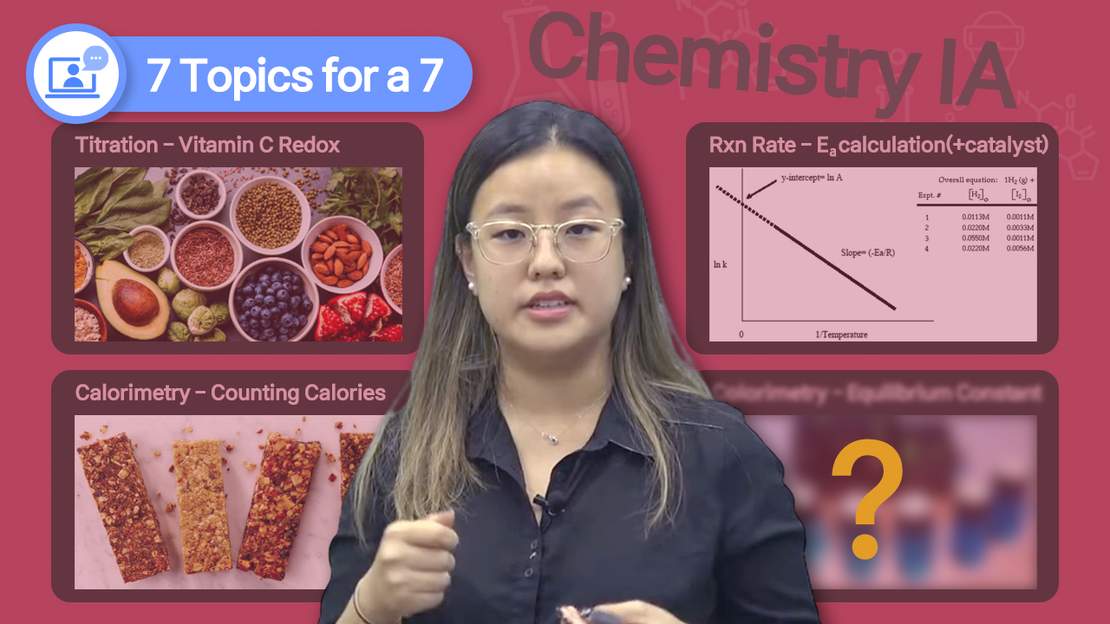
7 Topics to Get a 7 in IB Chemistry IA
Looking for IB Chemistry IA topic ideas? Choosing the right topic for your IB Chemistry Internal Assessment (IA) can significantly influence your final grade. In this guide, we explore seven strong IB Chemistry IA topics that can help you achieve a 7 — along with strategic advice on how to select and refine your research question.
Why Topic Selection Matters in IB Chemistry IA
Before exploring the seven topics, it is crucial to understand why choosing the right topic is foundational to success. First, feasibility matters. Your experiment must be safely conducted in a high school laboratory. Overly ambitious designs often lead to incomplete data or safety issues. Second, data volume and quality are critical. A strong IA requires sufficient quantitative data to reduce random error and support thorough analysis. The discussion and evaluation sections account for a significant portion of marks — without robust data, your analysis will be limited. Finally, balance breadth and specificity. Your topic should be broad enough to allow theoretical discussion but specific enough to avoid overwhelming scope. Precision in defining your independent and dependent variables is essential.
The 7 High-Scoring IB Chemistry IA Topics
1. Determining Activation Energy Experimentally
This investigation involves calculating activation energy using experimental data. By varying temperature and measuring reaction rate, you can construct an Arrhenius plot to determine activation energy from the slope. Many common reactions have published literature values for activation energy, allowing you to calculate percentage error and compare findings to established research. This topic demonstrates strong links between kinetics theory and experimental practice.
2. Investigating the Effect of a Catalyst on Activation Energy
An extension of Topic 1, this investigation compares activation energy with and without a catalyst. You perform the reaction twice: once with a catalyst and once without. By calculating and comparing activation energies, you can evaluate catalytic efficiency. Since catalytic systems are well-studied, literature comparison strengthens evaluation. This topic shows deeper analytical sophistication and earns high marks when executed well.
3. Calorimetry: Determining Energy Content of Food
This topic is ideal for students interested in nutrition or biochemistry. Using calorimetry, you can determine the enthalpy change of combustion for different food samples (e.g., energy bars). By burning a known mass beneath a water-filled beaker, measuring temperature change, and calculating energy released, you can compare your findings with manufacturer values. This allows for strong evaluation of heat loss, experimental limitations, and percentage error.
4. Vitamin C or Nutrient Analysis via Titration
Ascorbic acid (vitamin C) can be quantified using redox titration. You can measure vitamin C content in fruit juices or compare “superfoods.” Extensions include determining calcium in milk, caffeine in tea or coffee, or pH in fermented foods — all involving titration techniques. This topic provides excellent opportunities for quantitative precision and uncertainty analysis.
5. Organic Synthesis and Reaction Yield
This investigation involves synthesizing an organic compound using reactions from Topic 10/20. Examples include:
- Oxidation of alcohols
- Esterification reactions
- Bromination reactions You may measure yield, purity, or reaction rate, and connect findings to equilibrium or kinetics theory. For instance, oxidizing a primary alcohol to an aldehyde using distillation allows calculation of product yield. Organic synthesis topics demonstrate strong theoretical integration when well-controlled.
6. Determining Buffer Capacity
Although buffer capacity is not explicitly emphasized in the syllabus, it provides an advanced yet manageable extension of acid-base theory. By adding measured amounts of acid or base using a burette and monitoring pH changes, you can determine how buffer systems resist pH change. You may also investigate the effect of temperature or concentration on buffer capacity. This topic demonstrates conceptual depth and independent thinking.
7. Determining the Equilibrium Constant (Kc)
Equilibrium constants can be measured experimentally in various ways. One engaging method involves colorimetry. If a reaction involves a colored species, you can measure absorbance to determine concentration and calculate Kc. A colored reactant or product is essential for this method. This topic strongly integrates equilibrium theory and quantitative analysis.
Final Advice: What Makes a Strong IB Chemistry IA?
While these seven topics are strong examples, they are not exhaustive. Creativity and originality are always rewarded. However, high-scoring IAs consistently demonstrate:
- Clear personal engagement
- Strong theoretical understanding
- Explicit linkage between data and chemical principles
- Sufficient and reliable data for analysis
- Clearly defined independent and dependent variables Before finalizing your topic:
- Explore syllabus areas you genuinely find interesting.
- Discuss feasibility and safety with your teacher.
- Clearly define your research question and variables. A 7 in IB Chemistry IA is not about complexity — it is about clarity, structure, and scientific reasoning.